Registration

Monday, 18 July 2011

Generation of a Sinusoidal Waveform

In our tutorials about Electromagnetism, we saw how an electric current flowing through a conductor can be used to generate a magnetic field around itself, and also if a single wire conductor is moved or rotated within a stationary magnetic field, an "EMF", (Electro-Motive Force) will be induced within the conductor due to this movement. From this tutorial we learnt that a relationship exists between Electricity and Magnetism giving us, as Michael Faraday discovered the effect of "Electromagnetic Induction" and it is this basic principal that is used to generate a Sinusoidal Waveform.
Rotating Coil inside a Magnetic Field In the Electromagnetic Induction, tutorial we said that when a single wire conductor moves through a permanent magnetic field thereby cutting its lines of flux, an EMF is induced in it. However, if the conductor moves in parallel with the magnetic field in the case of points A and B, no lines of flux are cut and no EMF is induced into the conductor, but if the conductor moves at right angles to the magnetic field as in the case of points C and D, the maximum amount of magnetic flux is cut producing the maximum amount of induced EMF. Also, as the conductor cuts the magnetic field at different angles between points A and C, 0 and 90o the amount of induced EMF will lie somewhere between this zero and maximum value. Then the amount of emf induced within a conductor depends on the angle between the conductor and the magnetic flux as well as the strength of the magnetic field.
An AC generator uses the principal of Faraday's electromagnetic induction to convert a mechanical energy such as rotation, into electrical energy, a Sinusoidal Waveform. A simple generator consists of a pair of permanent magnets producing a fixed magnetic field between a north and a south pole. Inside this magnetic field is a single rectangular loop of wire that can be rotated around a fixed axis allowing it to cut the magnetic flux at various angles as shown below.

Monday, 4 July 2011

notice

keep checking for more notes and test................... email me at vishalchauhan888@gmail.com  for specific material
CBSE TEST PAPER-01
CLASS - XII PHYSICS (Electromagnetic Induction and Alternating current)
1. A metallic wire coil is stationary in a non – uniform magnetic field. What is the
emf. Induced in the coil?
[1]
2. Why does metallic piece becomes very hot when it is surrounded by a coil
carrying high frequency (H.F) alternating current?
[1]
3. IF the rate of change of current of 2A/s induces an emf of 1omV in a solenoid.
What is the self inductance of the solenoid?
[1]
4. A circular copper disc. 10 cm in radius rotates at a speed of 2
axis through its centre and perpendicular to the disc. A uniform magnetic field
of 0.2T acts perpendicular to the disc.
1) Calculate the potential difference developed between the axis of the disc
and the rim.
2) What is the induced current if the resistant of the disc is 2
[3]
5. How is the mutual inductance of a pair of coils affected when
(1) Separation between the coils is increased.
(2) The number of turns of each coil is increased.
(3) A thin iron sheet is placed between two coils, other factors remaining the
same. Explain answer in each case.
[3]
6. Distinguish between resistances, reactance and impedance of an a.c. circuit? [3]
7. A sinusoidal voltage V = 200 sin 314t is applied to a resistor of 10
p rad/s about anW?W
resistance. Calculate
(1) rms value of the voltage
(2) rms value of the current
(3) Power dissipated as heat in watt.
[3]
8. (a) State the condition under which the phenomenon of resonance occurs
in a series LCR circuit. Plot a graph showing the variation of current
with frequency of a.c. sources in a series LCR circuit.
(b) Show that in a series LCR circuit connected to an a.c. source exhibits
resonance at its natural frequency equal to
1/(LC)?

Download the above paper by click on following link:
http://www.mediafire.com/file/5549mkxu3yaw3eh/CBSE%20TEST%20PAPER.pdf


CBSE TEST PAPER-01
CLASS - XI PHYSICS (Kinematics)
Topic: - Motion in Straight Line
1. Under what condition is the relation
2. Two balls of different masses are thrown vertically upward with same initial speed.
Which one will rise to a greater height?
[1]
3. What is the relative velocity of two bodies having equal velocities? [1]
4. Write the characteristics of displacement? [2]
5. Draw displacement time graph for uniformly accelerated motion. What is its
shape?
[2]
6. Sameer went on his bike from Delhi to Gurgaon at a speed of 60km/hr and came
back at a speed of 40km/hr. what is his average speed for entire journey.
[2]
7. Define
8. A particle is moving along a straight line and its position is given by the relation
s =ut correct? [1]J = v + at from velocity time graph. [3]
x
= (t3 - 6t 2 -15t + 40)m
Find (a) The time at which velocity is zero.
(b) Position and displacement of the particle at that point.
(c) Acceleration for the particle at that line.
[3]
9. Velocity time graph of a moving particle is shown. Find the displacement (1) 0 – 4 s
(2) 0 – 8 (3) 0 12 s from the graph. Also write the differences between distance and
displacement.

Saturday, 25 June 2011


Direct Current (red curve). The horizontal axis measures time; the vertical, current or voltage.
Direct current (DC) is the unidirectional flow of electric charge. Direct current is produced by such sources as batteries, thermocouples, solar cells, and commutator-type electric machines of the dynamo type. Direct current may flow in a conductor such as a wire, but can also flow through semiconductors, insulators, or even through a vacuum as in electron or ion beams. The electric charge flows in a constant direction, distinguishing it from alternating current (AC). A term formerly used for direct current was galvanic current.[1]
Types of direct current.
Direct current may be obtained from an alternating current supply by use of a current-switching arrangement called a rectifier, which contains electronic elements (usually) or electromechanical elements (historically) that allow current to flow only in one direction. Direct current may be made into alternating current with an inverter or a motor-generator set.
The first commercial electric power transmission (developed by Thomas Edison in the late nineteenth century) used direct current. Because of the significant advantages of alternating current over direct current in transforming and transmission, electric power distribution is nearly all alternating current today. In the mid 1950s, HVDC transmission was developed, which is now replacing the older high voltage alternating current systems. For applications requiring direct current, such as third rail power systems, alternating current is distributed to a substation, which utilizes a rectifier to convert the power to direct current. See War of Currents.
Direct current is used to charge batteries, and in nearly all electronic systems, as the power supply. Very large quantities of direct-current power are used in production of aluminum and other electrochemical processes. Direct current is used for some railway propulsion, especially in urban areas. High-voltage direct current is used to transmit large amounts of power from remote generation sites or to interconnect alternating current power grids

Thursday, 23 June 2011

Vectors
  • Euclidean vector, a geometric entity endowed with both length and direction; an element of a Euclidean vector space. In physics, euclidean vectors are used to represent physical quantities which have both magnitude and direction, such as force, in contrast to scalar quantities, which have no direction.
    • Vector product, or cross product, an operation on two vectors in a three-dimensional Euclidean space, producing a third three-dimensional Euclidean vector
    • Vector projection, also known as the vector resolute, a mapping of one vector onto another
    • The vector part of a quaternion, a term used in 19th century mathematical literature on quaternions
    • Burgers vector, a vector that represents the magnitude and direction of the lattice distortion of dislocation in a crystal lattice
    • Displacement vector, a vector that specifies the change in position of a point relative to a previous position
    • Gradient vector, one vector in a vector field
    • Laplace–Runge–Lenz vector, a vector used chiefly to describe the shape and orientation of the orbit of one astronomical body around another
    • Normal vector, or surface normal, a vector which is perpendicular to a surface
    • Null vector, or zero vector, a vector whose components are all zero
    • Orbital state vectors, which define the state of an orbiting body
    • Position (vector), a vector which represents the position of an object in space in relation to an arbitrary reference point
    • Poynting vector, in physics, a vector representing the energy flux of an electromagnetic field
    • Tangent vector (disambiguation), a vector that follows the direction of a curve or a surface at a given point
    • Wave vector, a vector representation of a wave
  • Gyrovector, a hyperbolic geometry version of a vector
  • Axial vector, or pseudovector, a quantity that transforms like a vector under a proper rotation
  • Basis vector, one of a set of vectors (a "basis") that, in linear combination, can represent every vector in a given vector space
  • Coordinate vector, in linear algebra, an explicit representation of an element of any abstract vector space
  • Darboux vector, the areal velocity vector of the Frenet frame of a space curve
  • Four-vector, in the theory of relativity, a vector in a four-dimensional real vector space called Minkowski space
  • Interval vector, in musical set theory, an array that expresses the intervallic content of a pitch-class set
  • P-vector, the tensor obtained by taking linear combinations of the wedge product of p tangent vectors
  • Probability vector, in statistics, a vector with non-negative entries that add up to one
  • Row vector or column vector, a one-dimensional matrix often representing the solution of a system of linear equations
  • Spin vector, or Spinor, is an element of a complex vector space introduced to expand the notion of spatial vector
  • Tuple, an ordered list of numbers, sometimes used to represent a vector
  • Unit vector, a vector in a normed vector space whose length is 1
  • Vector, an element of a vector space

Sunday, 19 June 2011

Realize you are responsible for your life. The decisions, the choices you make are yours. Don't blame others for things not working out, take responsibility, change the things that need changing.
join me ..............for more notes.................

Friday, 17 June 2011

A capacitor which is an energy-storage device is used to store energy between two conductors. These conductors are also called plates. An insulator is placed between these two plates. These plates are charged in order to store energy. One of the main function of a capacitor is to work as a filter. In this process blocks DC (Direct Current) and passes AC (Alternating Current).

There are various types of capacitors according to their designs and mechanisms. However, choosing a capacitor becomes quite interesting job, especially when we need to choose one according to our needs.
capacitor-breakdown.jpg

For Bypassing High Frequency to the Ground :

Ceramic Capacitor : It has relatively poorer capacitance. It is mostly used in a high frequency circuit. It looks like a disk in shape. It has dielectrics made of titanium acid barium. Basically, it is used to bypass high frequency to the ground.

Multilayer Ceramic Capacitor : Its function is same as a ceramic capacitor as it too is used to bypass signals of high frequency to the ground. It is a non-polarized capacitor ( So it comes in non polarized section too) . As per name, it contains a dielectric made of many layers of ceramic. It behaves well with extreme temperature and high frequencies.

For Large Value Capacitance :

Aluminum Capacitor : It consists of two electrodes. One being a negative and the other a positive one. Hence it has polarity. Largely, these electrodes are made of aluminum. The capacity of a electrolytic capacitor is measured on the scale of µF .The minimum capacity can be µF . While the maximum can lead to near 1000 µF. At some extent it shares its features with coils. Thus an electrolytic capacitor is not termed as something suitable for high-frequency circuits. Thus it is best used for low-frequency circuits where it works as a ripple filter.

Tantalum Capacitor : It is a type of electrolytic capacitor. The difference lies in the material used for the electrodes. As the name suggests, the electrodes for this type of capacitor is made of tantalum. However, in the matter of capacity it is better than any aluminum electrolyte capacitor. It is suitable for an analog circuit. Unlike an aluminum electrolytic capacitor, it is suits well for a high-frequency circuit. However, the making of a tantalum electrolytic capacitor needs more investment of money.

Super Capacitor : Termed by many as super capacitor only because its high level of capacitance. However, its actual name is electric double layer capacitor. It needs a lot of protective measures like a protection circuit to run it. Its high capacitance is prone to excessive inflow of electric waves which may be destructive to the circuit.

Non-polarized :

Mica Capacitors : This capacitor is one of the most expensive capacitors. However, it carries low capacitance. It is very safe for high voltage circuits, high frequency filters and resonance circuits. It, a non-polarized capacitor, comes with very high quality of insulation.

Polystyrene Film Capacitors : Basically, it is used as filter circuits. Like a multilayer ceramic capacitor, it too is a non-polarized capacitor. As the name says, polystyrene is used for the making of dielectric. Internally, it has a shape like a coil. Thus it can be found to be suitable for low-frequency circuits only.

The Physics Classroom

Vectors: Motion and Forces in Two Dimensions - Lesson 2

Projectile Motion

Student Extras

Teacher's Guide

What is a Projectile?

In Unit 1 of the Physics Classroom Tutorial, we learned a variety of means to describe the 1-dimensional motion of objects. In Unit 2 of the Physics Classroom Tutorial, we learned how Newton's laws help to explain the motion (and specifically, the changes in the state of motion) of objects that are either at rest or moving in 1-dimension. Now in this unit we will apply both kinematic principles and Newton's laws of motion to understand and explain the motion of objects moving in two dimensions. The most common example of an object that is moving in two dimensions is a projectile. Thus, Lesson 2 of this unit is devoted to understanding the motion of projectiles.

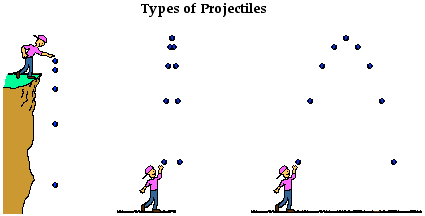
A projectile is an object upon which the only force acting is gravity. There are a variety of examples of projectiles. An object dropped from rest is a projectile (provided that the influence of air resistance is negligible). An object that is thrown vertically upward is also a projectile (provided that the influence of air resistance is negligible). And an object which is thrown upward at an angle to the horizontal is also a projectile (provided that the influence of air resistance is negligible). A projectile is any object that once projected or dropped continues in motion by its own inertia and is influenced only by the downward force of gravity.
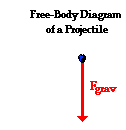
By definition, a projectile has a single force that acts upon it - the force of gravity. If there were any other force acting upon an object, then that object would not be a projectile. Thus, the free-body diagram of a projectile would show a single force acting downwards and labeled force of gravity (or simply Fgrav). Regardless of whether a projectile is moving downwards, upwards, upwards and rightwards, or downwards and leftwards, the free-body diagram of the projectile is still as depicted in the diagram at the right. By definition, a projectile is any object upon which the only force is gravity.


Projectile Motion and Inertia
Many students have difficulty with the concept that the only force acting upon an upward moving projectile is gravity. Their conception of motion prompts them to think that if an object is moving upward, then there must be an upward force. And if an object is moving upward and rightward, there must be both an upward and rightward force. Their belief is that forces cause motion; and if there is an upward motion then there must be an upward force. They reason, "How in the world can an object be moving upward if the only force acting upon it is gravity?" Such students do not believe in Newtonian physics (or at least do not believe strongly in Newtonian physics). Newton's laws suggest that forces are only required to cause an acceleration (not a motion). Recall from the Unit 2 that Newton's laws stood in direct opposition to the common misconception that a force is required to keep an object in motion. This idea is simply not true! A force is not required to keep an object in motion. A force is only required to maintain an acceleration. And in the case of a projectile that is moving upward, there is a downward force and a downward acceleration. That is, the object is moving upward and slowing down.
To further ponder this concept of the downward force and a downward acceleration for a projectile, consider a cannonball shot horizontally from a very high cliff at a high speed. And suppose for a moment that the gravity switch could be turned off such that the cannonball would travel in the absence of gravity? What would the motion of such a cannonball be like? How could its motion be described? According to Newton's first law of motion, such a cannonball would continue in motion in a straight line at constant speed. If not acted upon by an unbalanced force, "an object in motion will ...". This is Newton's law of inertia.
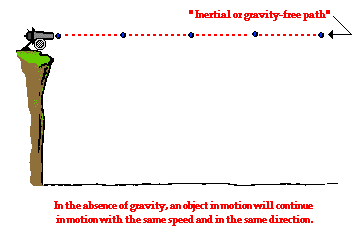

Now suppose that the gravity switch is turned on and that the cannonball is projected horizontally from the top of the same cliff. What effect will gravity have upon the motion of the cannonball? Will gravity affect the cannonball's horizontal motion? Will the cannonball travel a greater (or shorter) horizontal distance due to the influence of gravity? The answer to both of these questions is "No!" Gravity will act downwards upon the cannonball to affect its vertical motion. Gravity causes a vertical acceleration. The ball will drop vertically below its otherwise straight-line, inertial path. Gravity is the downward force upon a projectile that influences its vertical motion and causes the parabolic trajectory that is characteristic of projectiles.
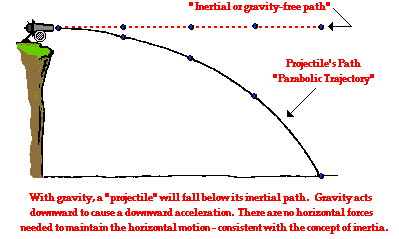
 

A projectile is an object upon which the only force is gravity. Gravity acts to influence the vertical motion of the projectile, thus causing a vertical acceleration. The horizontal motion of the projectile is the result of the tendency of any object in motion to remain in motion at constant velocity. Due to the absence of horizontal forces, a projectile remains in motion with a constant horizontal velocity. Horizontal forces are not required to keep a projectile moving horizontally. The only force acting upon a projectile is gravity!